
If you’re new to car maintenance, understanding OBD2 scanners can be a game changer. These tools help you diagnose issues quickly, saving you time and money. From basic models like the ANCEL AD310 to more advanced options like the BlueDriver, there’s something for everyone. Knowing what features to look for can make all the difference in your vehicle care journey. Let’s explore what these top scanners have to offer and how they can simplify your diagnostics.
ANCEL AD310 OBD II Scanner Car Engine Fault Code Reader

The ANCEL AD310 OBD II Scanner is an excellent choice for beginners looking to diagnose check engine light issues without any prior car knowledge. This compact tool reads and clears diagnostic trouble codes in seconds, making it user-friendly. It connects easily to vehicles from 1996 or newer, powered directly through the OBDII Data Link Connector—no batteries needed. With its sturdy build and clearly labeled buttons, you’ll find it easy to navigate. Plus, it focuses on emission-related problems, ensuring you get accurate results quickly. Overall, the ANCEL AD310 is a reliable option for anyone wanting to troubleshoot their car’s engine efficiently.
Best For: The ANCEL AD310 OBD II Scanner is best for beginners and casual users who want to diagnose check engine light issues without prior car knowledge.
Pros:
- Easy to use with a user-friendly interface and clearly labeled buttons.
- No batteries required as it powers directly through the OBDII Data Link Connector.
- Fast and accurate readings of diagnostic trouble codes related to emission systems.
Cons:
- Limited to reading only emission-related engine fault codes; cannot access non-emission codes.
- Only compatible with vehicles from 1996 or newer that support OBDII protocol.
- Does not support OBDI vehicles, limiting its use for older models.
BlueDriver Bluetooth Pro OBDII Scan Tool for iPhone & Android

For those new to car diagnostics, the BlueDriver Bluetooth Pro OBDII Scan Tool is a top choice due to its user-friendly app that simplifies the troubleshooting process. Compatible with gas vehicles from 1996 and newer, it diagnoses over 7,000 issues, including check engine, ABS, and airbag faults. The scanner connects wirelessly to your phone or tablet, providing real-time health monitoring. You’ll appreciate the unlimited repair reports and access to repair videos that guide you through fixes. Plus, there are no subscription fees, and customer support is available 24/7. With a solid warranty, it’s a smart investment for beginners.
Best For: Beginners looking for an easy-to-use OBDII scanner that offers comprehensive diagnostics and repair guidance for their vehicles.
Pros:
- User-friendly app with step-by-step repair videos and unlimited repair reports.
- Wireless Bluetooth connectivity allows for real-time monitoring while driving.
- One-time purchase with no subscription fees and 24/7 customer support.
Cons:
- Limited to gas vehicles from 1996 and newer, excluding older models and diesel vehicles.
- Some users may find the app interface less intuitive compared to other professional tools.
- Advanced features may not be as robust as those found in higher-end diagnostic tools.
FOXWELL NT301 OBD2 Scanner for Check Engine Light

Designed with beginners in mind, the FOXWELL NT301 OBD2 Scanner simplifies the process of diagnosing check engine light issues. This professional mechanic tool allows you to read diagnostic trouble codes (DTCs), check emissions readiness, and turn off the check engine light with ease. You can also view live data graphs for sensors, helping you track performance trends. Compatible with most 1996+ gasoline vehicles and many 2000+ models, it features a user-friendly 2.8” color display and dedicated hotkeys for emissions testing. Plus, enjoy peace of mind with a 1-year assurance and lifetime updates for your scanner.
Best For: The FOXWELL NT301 OBD2 Scanner is best for DIY car owners and beginners looking for an accessible tool to diagnose check engine light issues and monitor vehicle performance.
Pros:
- User-friendly design with a 2.8” color display and dedicated hotkeys for easy navigation.
- Compatibility with most 1996+ gasoline vehicles and many 2000+ models, making it versatile for various users.
- Live data graphing feature allows for real-time monitoring of sensor performance trends.
Cons:
- Limited functionality as it does not support advanced systems like ABS, SRS, or special resets.
- Compatibility varies by vehicle model, year, and VIN, potentially limiting effectiveness for some users.
- Not a professional scan tool, which may be a drawback for those needing in-depth diagnostics.
ANCEL AD410 Enhanced OBD2 Scanner for All OBDII Cars

Ancel AD410 Enhanced OBD2 Scanner stands out as an excellent choice for beginners looking to diagnose check engine issues without complexity. It’s compatible with all OBDII vehicles, including 1996 US models and newer, making it versatile for various car owners. With a clear 2.4-inch TFT display, you’ll easily access your emissions-related fault codes and definitions from over 42,000 built-in DTC lookups. Plus, its user-friendly interface allows for quick resets and monitor readiness checks. Powered directly through the vehicle’s OBDII connector, you won’t need extra batteries. With a solid customer rating and years of trusted support, it’s a smart investment.
Best For: Beginners and car owners who want an easy-to-use tool for diagnosing check engine issues on OBDII vehicles.
Pros:
- User-friendly interface with a clear 2.4-inch TFT display for easy navigation.
- Compatible with a wide range of vehicles, including those from 1996 and newer.
- Provides quick access to over 42,000 built-in DTC lookups for efficient fault code understanding.
Cons:
- Limited functionality beyond basic OBDII diagnostics and fault code reading.
- Requires a connection to the vehicle’s OBDII port, which may limit mobility while diagnosing.
- USB cable is only for updates, not for live data streaming or additional features.
MOTOPOWER Car OBD2 Scanner Code Reader (MP69033)

The MOTOPOWER Car OBD2 Scanner Code Reader (MP69033) stands out as an ideal choice for beginners looking to understand their vehicle’s diagnostics without overwhelming complexity. It’s compatible with all OBD II protocol cars since 1996 and supports nine protocols, making it versatile. You can easily read and erase codes, view freeze frames, and monitor real-time data with its 2.8-inch LCD display. The compact design includes a 2.5-foot cable and six navigation buttons. While it doesn’t support ABS or Airbag systems, it’s straightforward to use—just plug it in, turn on the ignition, and you’re ready to go.
Best For: The MOTOPOWER Car OBD2 Scanner Code Reader (MP69033) is best for beginners who want a simple and effective tool for diagnosing vehicle issues without the complexity of advanced features.
Pros:
- Supports all OBD II protocol cars since 1996 and nine different protocols for broad compatibility.
- User-friendly with a 2.8-inch LCD display, simple navigation buttons, and a compact design for easy handling.
- Enables reading and erasing of codes, viewing freeze frames, and monitoring real-time data.
Cons:
- Does not support ABS, Airbag, or Oil Service Light systems, limiting its diagnostic capabilities.
- Limited to OBDII systems only, which may not suffice for more advanced automotive diagnostics.
- May require additional assistance from MOTOPOWER for connection issues, which could be inconvenient for some users.
FOXWELL NT604 Elite OBD2 Scanner for Cars and Trucks

If you’re a beginner looking for a reliable OBD2 scanner, the FOXWELL NT604 Elite is an excellent choice due to its user-friendly design and extensive diagnostic capabilities. This 5-in-1 tool covers OBDII diagnosis, ABS, SRS, and transmission checks, making it versatile for various vehicles. You’ll love the live data stream and built-in DTC library, enhancing your diagnostic experience. With no software downloads required, it’s ready to use right out of the box. Plus, its durable case guarantees longevity. Keep in mind, though, it’s strictly for diagnostics, not repairs, so check compatibility with your vehicle beforehand.
Best For: The FOXWELL NT604 Elite is best for beginners and DIY enthusiasts seeking an easy-to-use OBD2 scanner with comprehensive diagnostic features.
Pros:
- 5-in-1 diagnostic tool that covers OBDII, ABS, SRS, and transmission checks.
- User-friendly design with no software downloads needed, ready to use straight out of the box.
- Durable protective case ensuring longevity and resistance to damage.
Cons:
- Not a repair tool, limited to diagnostics and cannot perform maintenance functions.
- Compatibility limitations may affect performance based on vehicle make, model, and year.
- No advanced features for professional mechanics compared to higher-end models.
Innova 5210 OBD2 Scanner & Engine Code Reader

For those new to car diagnostics, the Innova 5210 OBD2 Scanner & Engine Code Reader stands out as an excellent choice. This versatile tool reads and clears check engine and ABS codes, providing access to live data like RPM and engine temperature. It’s compatible with most vehicles from 1996 onward, ensuring broad coverage. The built-in battery tester helps monitor alternator health, while the oil light reset feature simplifies maintenance. Plus, its integration with the RepairSolutions2 app offers real-world repair guidance without hidden fees. Use Innova’s coverage checker to verify compatibility for your specific vehicle model.
Best For: DIY car enthusiasts and beginners looking for an affordable and comprehensive diagnostic tool for most vehicles.
Pros:
- Reads and clears both check engine and ABS codes, providing essential diagnostic information.
- Bluetooth compatibility with the RepairSolutions2 app offers step-by-step repair guidance and verified fixes.
- Built-in battery tester and oil light reset feature simplify vehicle maintenance and prevent breakdowns.
Cons:
- Compatibility may vary across makes, models, and years, requiring users to verify with Innova’s coverage checker.
- Limited advanced features compared to higher-end models, which may not satisfy professional mechanics.
- Live data access could be limited for some vehicle types, impacting the depth of diagnostics available.
Innova 5610 OBD2 Bidirectional Scan Tool

Looking for a user-friendly scan tool that can grow with your skills? The Innova 5610 OBD2 Bidirectional Scan Tool’s got you covered. It diagnoses vehicle issues and provides access to live data for most 1996-2023 OBD2 vehicles. With bidirectional controls, you can test functions like the fuel pump and electronic parking brake. Plus, it offers special reset functions for advanced systems. You’ll appreciate its ease of use, supporting multiple languages, and the included protective boot and USB cable. Enjoy reliable technical support and free updates, making this tool perfect for beginners ready to advance their automotive knowledge.
Best For: Beginners and intermediate users looking for a versatile and user-friendly OBD2 scan tool to diagnose vehicle issues and access live data.
Pros:
- Supports a wide range of OBD2 vehicles from 1996 to 2023, ensuring broad compatibility.
- Offers bidirectional controls for testing various vehicle functions, enhancing diagnostic capabilities.
- Provides free updates and reliable technical support, allowing users to stay current without extra costs.
Cons:
- May lack some advanced features found in higher-end diagnostic tools, limiting its use for professional mechanics.
- Some users might find the interface less intuitive compared to more expensive models.
- The included protective boot may not provide the same level of durability as aftermarket options.
OBDLink MX+ OBD2 Bluetooth Scanner for iPhone, Android, and Windows

The OBDLink MX+ OBD2 Bluetooth Scanner is ideal for beginners who want to turn their smartphones or tablets into professional-grade diagnostic tools. It’s compatible with iPhone, Android, and Windows, making it versatile for any user. With the ability to clear the Check Engine Light and monitor live parameters like ABS and SRS, you’ll have access to essential information. Enhanced support for brands like Ford, GM, and Toyota guarantees you’re covered. Plus, its lightweight design and built-in safety features, including over-voltage protection, make it a smart choice for car diagnostics. With a 4.6-star rating from over 15,000 reviews, you can’t go wrong!
Best For: Beginners who want to transform their smartphones or tablets into professional-grade car diagnostic tools.
Pros:
- Compatible with iPhone, Android, and Windows for versatile use.
- Ability to clear Check Engine Lights and monitor live parameters like ABS and SRS.
- Lightweight design with built-in safety features, including over-voltage protection.
Cons:
- Limited to specific car brands for enhanced OEM support.
- May require additional apps for full functionality, depending on user needs.
- Some users may find the setup process complex if they are not tech-savvy.
VDIAGTOOL VD10 OBD2 Scanner Code Reader for All OBDII Protocol Cars
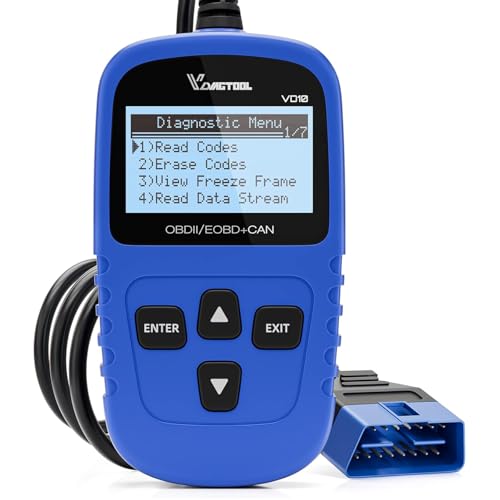
If you want a straightforward and user-friendly diagnostic tool, the VDIAGTOOL VD10 OBD2 Scanner Code Reader is perfect for beginners. This plug-and-play device connects directly to your car’s OBDII port without needing batteries. It supports all OBDII protocols, making it compatible with 99% of vehicles post-1996. You can easily read and clear fault codes, check I/M readiness, and access live data from your engine sensors. With a 2-line LCD screen and built-in database of over 3,000 codes, diagnosing issues is simple. Plus, it comes with a 3-year warranty and lifetime free updates for peace of mind.
Best For: The VDIAGTOOL VD10 OBD2 Scanner Code Reader is best for beginners and DIY car enthusiasts looking for an easy-to-use diagnostic tool.
Pros:
- User-friendly: Plug-and-play design allows for quick and hassle-free setup.
- Wide compatibility: Works with 99% of OBDII-compliant vehicles, covering a broad range of models.
- Comprehensive diagnostics: Offers code reading, live data access, and freeze frame functionality for thorough vehicle assessments.
Cons:
- Limited advanced features: May not offer the extensive capabilities found in more advanced diagnostic tools.
- Basic display: The 2-line LCD screen may be less user-friendly compared to larger, color screens found in higher-end models.
- No battery or charger: While it connects directly to the OBDII port, it lacks portability for use outside the vehicle without a power source.
Factors to Consider When Choosing an OBD2 Scanner for Beginners
When you’re picking an OBD2 scanner, you’ll want to contemplate several key factors. Think about compatibility with your vehicle, ease of use, and the diagnostic capabilities it offers. Also, don’t overlook display quality and connectivity options, as these can greatly enhance your experience.
Compatibility With Vehicles
Choosing the right OBD2 scanner hinges on its compatibility with your vehicle. Make certain it works with cars from 1996 or newer, as they typically support the OBDII protocol. Check if the scanner covers all OBDII protocols, including KWP2000, J1850 VPW, ISO9141, J1850 PWM, and CAN, to guarantee it fits various makes and models. Verify that it’s compatible with both domestic and international vehicles, especially those from Europe and Asia made after 2000. Look for specific compatibility information for gasoline cars, light trucks, and diesel vehicles to avoid mismatches. Finally, consider scanners that provide updated compatibility lists to keep pace with evolving automotive technology. This will ensure your scanner remains useful for years to come.
Ease of Use
Finding a compatible OBD2 scanner is just the start; ease of use plays a significant role for beginners. Look for scanners with a plug-and-play design that connects directly to your vehicle’s OBDII port, eliminating the need for batteries or chargers. Choose devices with clear, user-friendly interfaces, like large LCD screens with adjustable contrast and backlighting, ensuring you can easily read diagnostic information. Intuitive navigation with clearly labeled buttons will let you quickly access essential functions, such as reading and clearing codes. Opt for models that include built-in databases of diagnostic trouble codes (DTCs) with definitions, so you don’t need external references. Real-time data display and I/M readiness checks can also help you assess your vehicle’s emissions status effectively.
Diagnostic Capabilities
Diagnostic capabilities are key factors to evaluate in an OBD2 scanner, especially for beginners. You’ll want a scanner that can read and clear diagnostic trouble codes (DTCs) for both generic and manufacturer-specific issues, as this is vital for effective troubleshooting. Look for devices that provide enhanced diagnostics, allowing access to advanced information like ABS and SRS codes. It’s also important that the scanner displays live data in real-time, helping you monitor your vehicle’s health while driving. Features like freeze frame data can capture vehicle conditions at fault occurrence, making problem identification easier. Finally, verify the scanner is compatible with various OBDII protocols to work with a wide range of vehicles, particularly those made since 1996.
Display Quality
When evaluating an OBD2 scanner, display quality is a significant aspect that can greatly impact your user experience. You’ll want to take into account the type of screen—options range from basic monochrome to bright color displays that enhance visibility in different lighting. A higher resolution, like 128×64 pixels or better, guarantees clearer text and detailed graphical data, which is essential when analyzing live data or fault codes. Larger screens, ideally 2.8 inches or more, allow you to view more information at a glance, reducing the need for excessive scrolling. Features like adjustable brightness and contrast can improve usability in low light or bright sunlight, while advanced display options, like live data graphing, help you track vehicle performance metrics easily.
Connectivity Options
Connectivity options play an essential role in your experience with OBD2 scanners, especially as you navigate through various diagnostics. You’ll typically find wired connections through the OBDII port and wireless options like Bluetooth or Wi-Fi. Bluetooth-enabled scanners are particularly convenient, allowing you to connect to your smartphone or tablet and access diagnostic information via dedicated apps without any cables. However, some scanners require a direct connection, limiting your mobility. When selecting a scanner, verify it’s compatible with your device’s operating system—whether it’s iOS, Android, or Windows—for the best functionality. Wireless scanners often provide real-time data access and advanced features, making them a popular choice for those seeking convenience in their diagnostic tasks.